
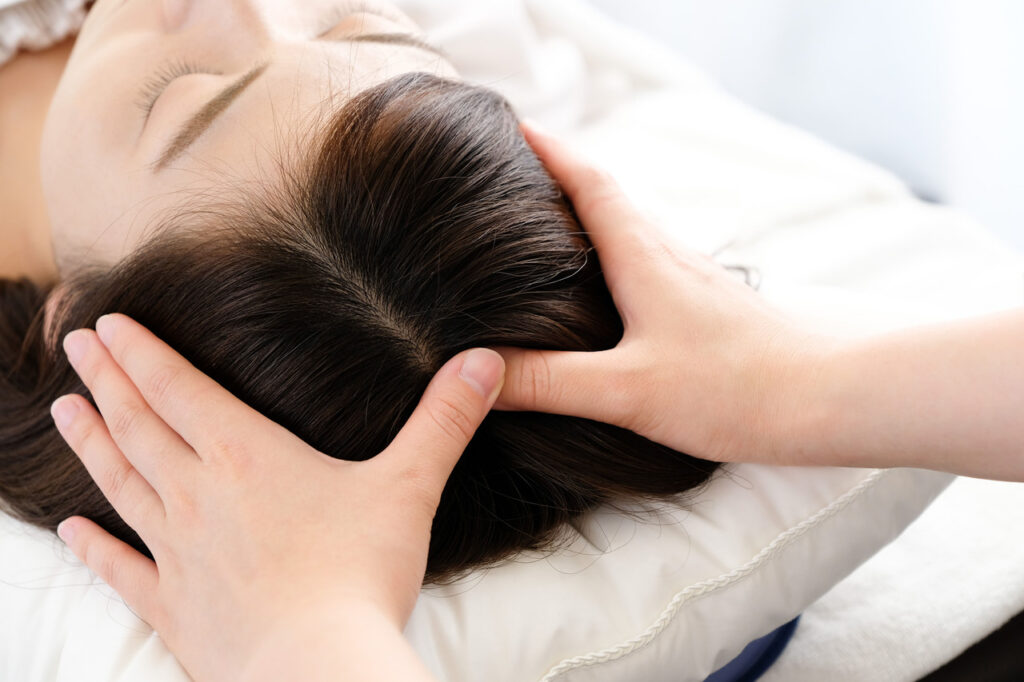
If you have ever felt your shoulders drop during a good head massage at the salon, you already know it feels wonderful. What is less obvious though, is whether it does anything for your hair. Does a head and scalp massage benefit your hair in any way, or is it merely just to feel good? This is a fair question that gets asked by customers who want to go beyond the surface and cares about what actually matters when it comes to their scalp health.
The bottom line? A scalp massage may support hair growth by increasing blood flow to the follicles and applying gentle stretching force to the cells that control hair thickness. There are small studies that have measured modest increases in hair thickness after several months of daily massage. The massage works best alongside treatment, but not instead of it.
Keep reading to find out what we know, how it is done correctly, and where the honest limits are when it comes to contributing to your scalp health.
What a Scalp Massage Actually Does
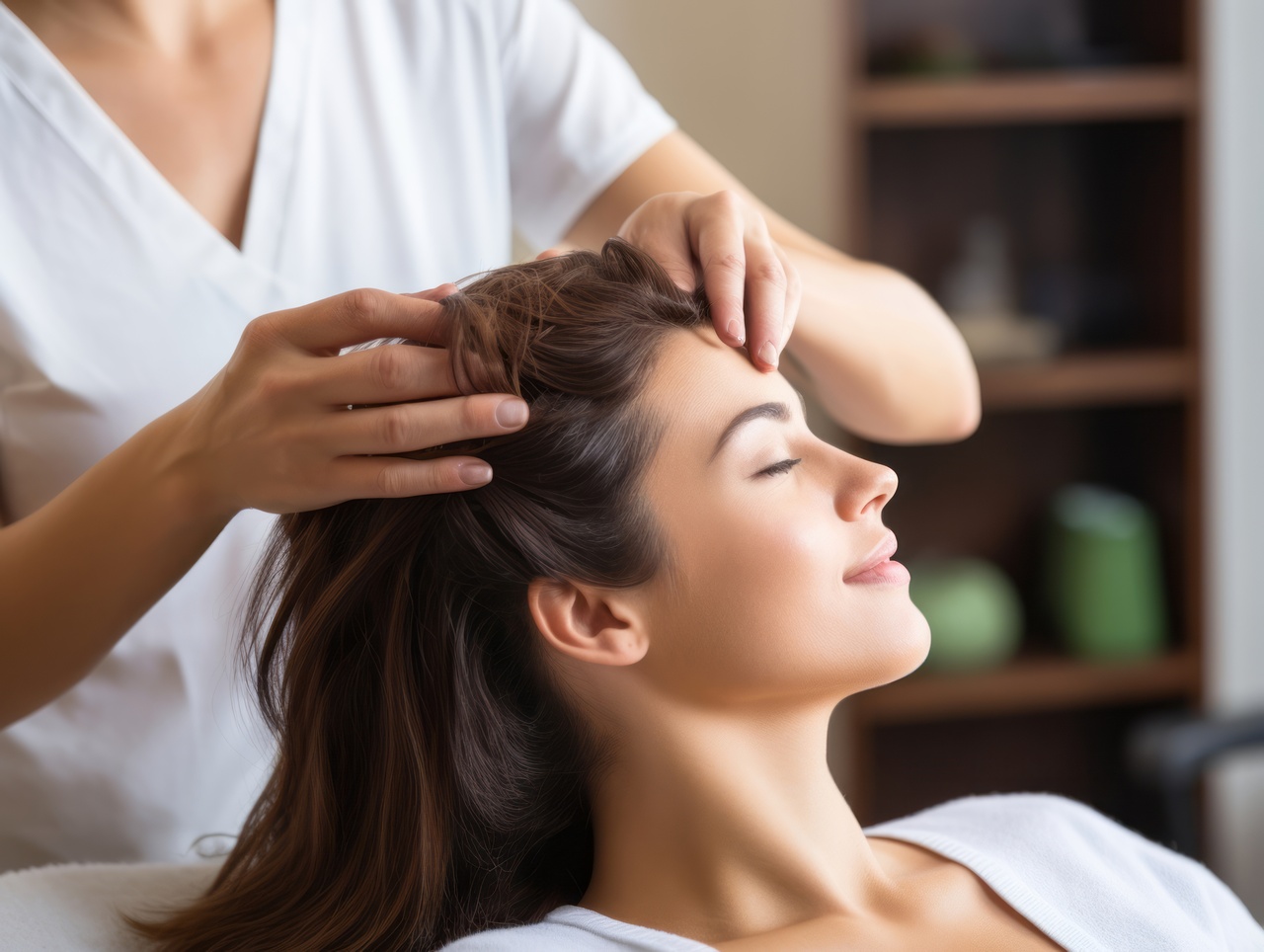
There are three things that happen when you massage your scalp properly.
Blood Flow Through Your Scalp Increases
Under your scalp, each hair follicle is fed by tiny blood vessels that deliver oxygen and nutrients. Massaging your scalp temporarily widens those vessels and increases blood circulation to the area. Enhanced blood circulation in the scalp helps with nutrient delivery and is seen as beneficial to hair health. Though it is only one factor against hair and scalp problems, it is a desirable outcome of those seeking scalp massage.
Scalp Tissue Gets Stretched
Did you know? Scalp tissue responds to physical force down to the genetic level, directly affecting how your hair grows. At the base of every follicle sits a small cluster of cells that governs how thick a hair grows and how long it stays in its growing phase. When the massage is applied to the scalp, those cells respond to the physical force exerted. Stretch them gently and repeatedly, and their behaviour changes at a genetic level, influencing your hair growth.
The Tension in Your Scalp Releases
Your scalp can also hold tension whenever you accumulate stress, and that also affects your hair and scalp health. The scalp sits on a sheet of connective tissue that tightens with stress, poor sleep, and long hours at a screen. A tight scalp is not the cause of hair loss, but a relaxed one is definitely a healthier environment for hair, making stress reduction itself well worth it.
What the Research Shows
There are two studies that are usually cited, both of which contribute their findings on the effects of massage on the scalp.
The first study presents Japanese researchers asking nine healthy men to use a standardised four-minute scalp massage every day for 24 weeks.¹ Hair thickness was measured at the start and the end of the study, increasing from 0.085mm to 0.092mm. The same team also applied stretching force to follicle cells in the laboratory and found measurable changes in the genes that regulate hair growth.
The second study presents a survey of 340 people with pattern hair loss who performed around 20 minutes of scalp massage daily.² Roughly two thirds reported that their hair loss had slowed or improved.
With the results of the two studies, this adds up to a small, measurable effect on hair thickness with a plausible mechanism behind it. However, this does not mean immediate proof that massage regrows lost hair, since the studies leave gaps that further determine any direct effectiveness towards hair regrowth.
In other words, while head and scalp massages are worth doing, they serve as a supplement and not a substitute for clinical treatment.
How to Massage Your Scalp for Hair Growth

When it comes to massaging your own scalp at home, the technique you use matters more than merely putting in hard effort. Here’s how you should massage your scalp:
- Use your fingertips: Use the pads of your fingers, and do not scratch using your finger nails. Purposefully scratching the scalp can cause irritation or small breaks in the skin, which can lead to infection and even hair loss.
- Apply firm, steady pressure: Apply enough pressure that you feel the scalp move under your fingers, but not so much that it hurts.
- Move the scalp, don’t rub the hair: Place your fingertips through your hair, press in on the scalp, and move the skin itself in small circles without rubbing the hair. Rubbing hair against hair causes friction and breakage without reaching the scalp at all
- Work in sections: Start at your hairline and work your way toward the back of the head. After that, the sides above your ears, then the crown, then the base of the skull where tension tends to collect.
- Spend four to five minutes: Set a timer for five minutes for the first few times you do your scalp massage. Most people stop at around 90 seconds thinking it has been five minutes.
- Finish at the back of the neck: Your last movement is to apply firm pressure along the base of the skull where the neck muscles attach.
How Often Should I Massage My Scalp?
You should massage your scalp daily. The pattern observed in the earlier mentioned two studies provides a strong case for this. A reasonable target you can aim for is massaging your scalp for four to five minutes a day. Five minutes of massaging your scalp daily will do more than only doing it for forty minutes once a week. After all, consistency matters more than duration when it comes to overall results in the long term.
Give that a go consistently for at least three to four months before you judge the results for yourself. Hair grows roughly one centimetre a month so any duration below one month is usually too early to tell.
Dry Massage, With Oil, or in the Shower?
All three options work, so the choice is mostly practical based on what works best for you.
Dry massage gives you the best grip on the scalp, which makes it the easiest way to get the technique right.
Massaging with oil is the traditional approach across much of Asia, and there is nothing wrong with it. Coconut, argan, and jojoba oils are all fine. Keep it to once or twice a week and wash it out properly, as leaving oil on an already oily scalp in Malaysian humidity invites irritation and flaking.
The most convenient option though, is in the shower while shampooing which makes it the easiest to build into a routine you can actually keep. Be gentle, as wet hair stretches and breaks more readily than dry hair.
Mistakes That Undo the Benefit
- Using your nails. This is the most common mistake. Scratching an itchy scalp with your nails might feel good, but it actually makes the itch worse.
- Going too hard. Aggressive massaging can cause skin breakage and, in some people, inflammation. Be firm with your massage, don’t press/rub too hard that it becomes punishing.
- Massaging an inflamed scalp. If your scalp is sore, broken out, or actively flaking, you should treat that first. Massaging will only aggravate it.
- Tugging at the roots. Pulling on hair, especially wet hair, puts stress on the follicle. When you do that, you are moving skin, not hair.
A Note on Malaysian Scalps

Our hot and humid climate in Malaysia plays a factor in how our scalp is conditioned. Constant humidity means most people here produce more sebum and sweat more at the scalp than they would in a dry climate, which is why oily roots and flaking are so common, and why heavy oil treatments often backfire.
If you cover your hair, moisture and heat get trapped against the scalp for most of the day. That is not a reason to avoid covering it, but it does mean the scalp benefits from being allowed to dry fully and from a regular wash routine. Tying your hair back while it is still damp is worth avoiding for the same reason.
Massaging the scalp helps in both cases, partly because moving the scalp helps distribute natural oils rather than letting them pool at the roots.
What a Scalp Massage Can and Cannot Do
There are a few things that a scalp massage can and cannot do for you.
What it Can Reasonably Do
A scalp massage improves blood circulation to the follicles. It also supports a healthier scalp environment, reduces tension, and helps the hair you currently have look and feel thicker, as well as possibly adding a small amount of measurable thickness over several months.
What it Cannot Do
A scalp massage cannot reverse pattern hair loss. Male and female pattern hair loss is driven by how your follicles respond to hormones, and no amount of massage changes that. A follicle that has already shrunk past a certain point will not come back because you massaged it.
This is the difference between scalp care and hair loss treatment. Scalp massage is excellent scalp care. But if you are losing hair in a pattern (a widening parting, thinning at the crown, a receding hairline) a massage alone will not hold it, and the months spent hoping it will are also continuing to lose more hair.
For that, it is recommended to go with medically supervised treatment: minoxidil and finasteride as the foundation, with regenerative options such as PRP or exosome therapy layered on where appropriate based on what’s prescribed upon your scalp analysis consultation. A scalp massage sits alongside those treatments comfortably, not as a replacement.
When to Get Your Scalp Looked At
Here are some signs that are worth a professional assessment rather than another few months of waiting:
- Your parting has visibly widened
- Your hairline has moved back at the temples
- More scalp shows through under bright light than it used to
- Shedding has increased noticeably and stayed that way for more than three months
- Your scalp is persistently itchy, flaking, or sore
- You are already using something and cannot tell whether it is working
A clinical scalp analysis uses magnified imaging to measure hair density and follicle condition directly, which gives you a number instead of an impression. If your hair is thinning, you will know by how much and where. If it is not, you will know that too.
Professional Scalp Care at DR-Hair
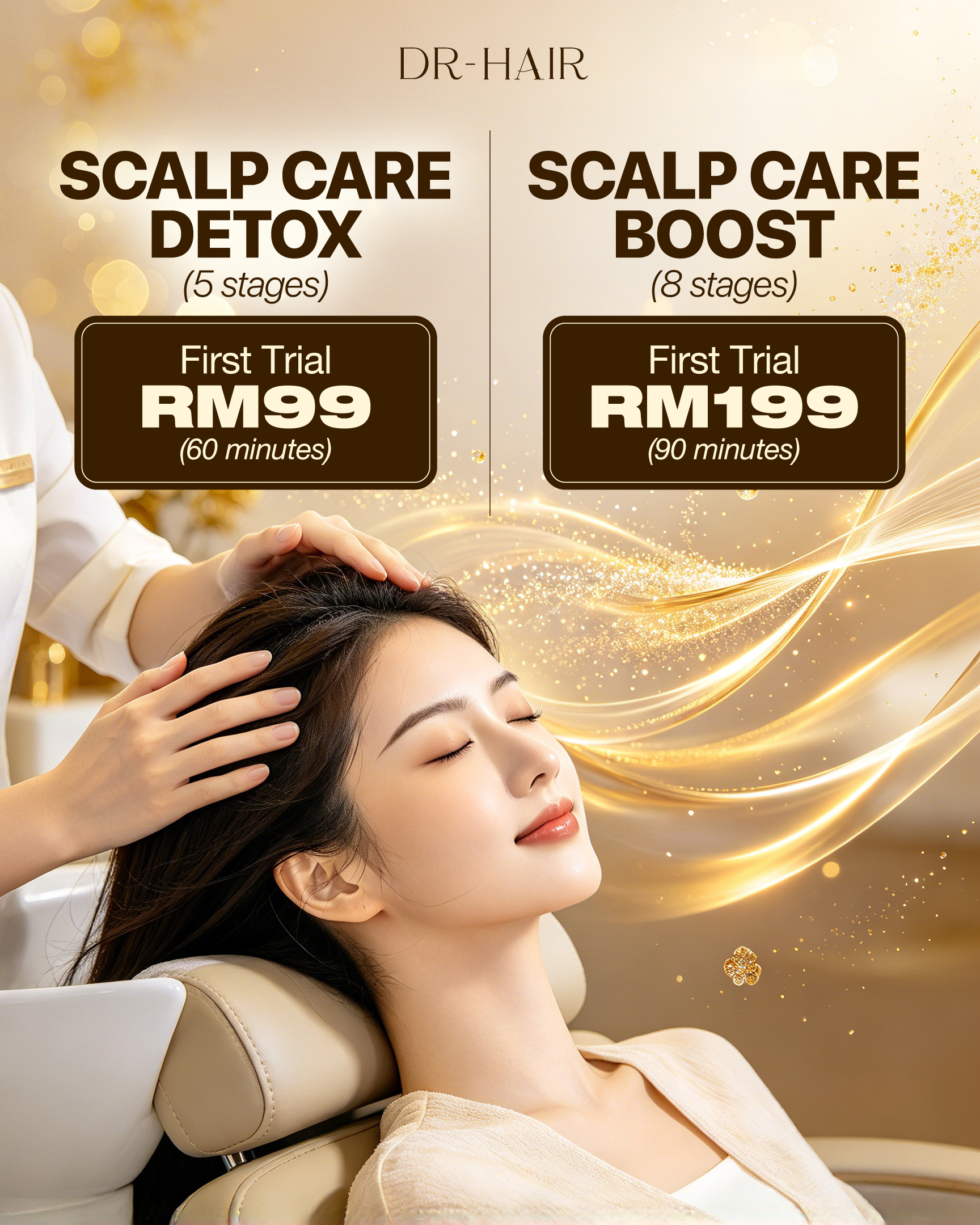
At DR-Hair, we provide scalp care treatments for your needs. Choose our Scalp Care Detox package at RM99 for the first trial (60 minutes, 5 stages), or our Scalp Care Boost package at RM199 for the first trial (90 minutes, 8 stages). Worried about your scalp health? Book a 20-minute digital scan and consultation with us today, and we will scan your scalp to check your condition, oil production, and follicle health to prescribe you the best treatment for your scalp and hair.
Every assessment is carried out under the supervision of a registered medical doctor, at our clinic in Damansara Utama, Petaling Jaya. Contact us for more details.
References
- Koyama T, Kobayashi K, Hama T, Murakami K, Ogawa R. Standardized scalp massage results in increased hair thickness by inducing stretching forces to dermal papilla cells in the subcutaneous tissue. Eplasty. 2016;16:e8. https://pmc.ncbi.nlm.nih.gov/articles/PMC4740347/
- English RS Jr, Barazesh JM. Self-assessments of standardized scalp massages for androgenic alopecia: survey results. Dermatol Ther (Heidelb). 2019;9(1):167–178. https://pubmed.ncbi.nlm.nih.gov/30671883/